Soccer is a global phenomenon that captivates millions of young players, but keeping children engaged during practice requires more than just rolling out a ball. For coaches and parents, the challenge lies in balancing technical development with genuine enjoyment.
Structured drills often feel repetitive to young minds, leading to a loss of focus and enthusiasm. However, when skill acquisition is disguised as a game, players work harder and learn faster without realizing they are performing intense repetitions.
This guide explores high-energy soccer drills designed to improve dribbling, passing, and game intelligence. By utilizing specific coaching cues and gamification strategies, you can transform a standard practice session into a dynamic learning environment.
The Philosophy of Gamification in Youth Development
Gamification in sports training involves applying game-design elements to practice activities. This approach is particularly effective for players under the age of twelve, who are in the “golden age” of motor learning. Instead of standing in lines, which reduces touches on the ball, players should be constantly moving and solving problems.
The primary goal is to maximize “ball rolling time.” In a traditional line drill, a player might touch the ball once every minute. In a gamified environment, that same player might touch the ball hundreds of times in the same duration.
Furthermore, games introduce the element of pressure in a psychological safe space. When a child tries to beat a high score or a timer, they naturally increase their intensity. This mimics the pressure of a real match more effectively than unopposed technical exercises.
Dribbling Mastery and Close Control Games
Dribbling is the foundation of individual soccer confidence. The objective at the youth level is to develop comfort using all surfaces of the foot—inside, outside, laces, and sole. Drills in this category focus on keeping the ball close while navigating traffic.
The Grid of Chaos
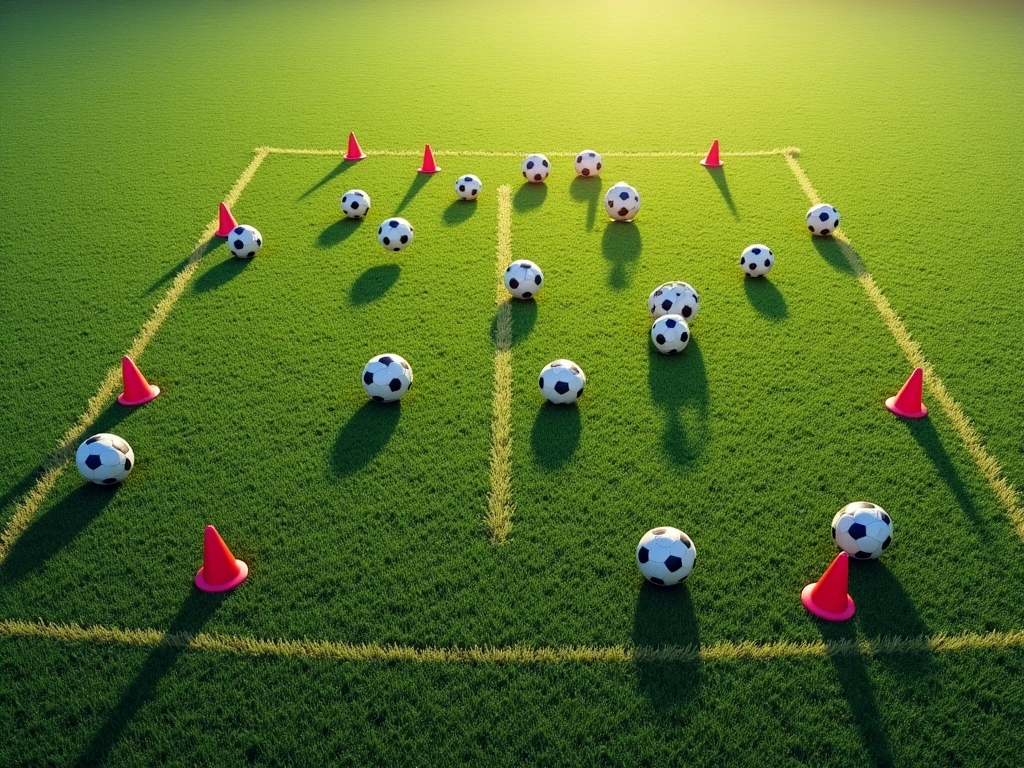
This activity creates a high-traffic environment that forces players to keep their heads up. Mark out a square grid, approximately 20 by 20 yards, depending on the number of players. Every player has a ball inside the grid.
On the coach’s whistle, players must dribble anywhere they want within the square without colliding with others or their balls. The coach can shout commands like “turn,” “accelerate,” or “stop.” This forces players to practice spatial awareness and scanning, which are critical for avoiding defenders in real games.
To advance the drill, introduce a “shark” player who does not have a ball. The shark’s job is to kick other players’ balls out of the grid. The dribblers must use their bodies to shield the ball, introducing the concept of physical protection and balance.
Traffic Light Control
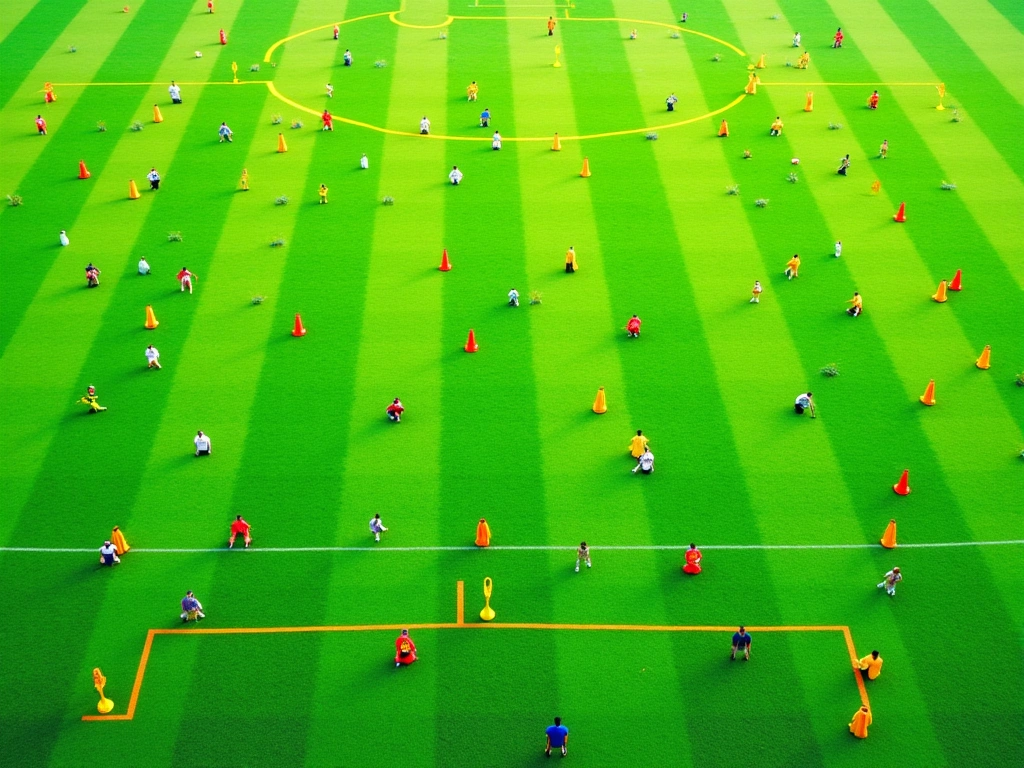
This is an evolution of the classic playground game, adapted for technical precision. Players line up on one side of the field with a ball. The coach stands at the opposite end acting as the traffic light.
“Green light” means dribble fast with the laces (instep). “Yellow light” means perform toe-taps or foundations in place. “Red light” requires an immediate stop with the sole of the foot. If a player moves after “red light,” they must take five steps back.
This drill teaches change of pace and the ability to stop the ball instantly. It reinforces the habit of keeping the ball close enough to stop it on command, preventing the “kick and chase” style often seen in beginners.
Passing Accuracy and Weight of Pass
Passing is the connective tissue of a soccer team. For kids, the difficulty lies not just in direction, but in the “weight” of the pass—how hard or soft they kick the ball. Drills here should emphasize the inside of the foot for accuracy.
Gate Crashing
Set up pairs of cones (gates) scattered randomly throughout the field. The gates should be about three feet wide. Divide players into pairs, with one ball per pair.
The objective is for the pair to pass the ball through as many gates as possible in 60 seconds. They cannot pass through the same gate twice in a row. This encourages movement off the ball and communication.
Coaches should watch for proper mechanics: the standing foot pointed at the target and the striking ankle locked. This drill also introduces the concept of passing into space rather than just passing to a static person.
The Rondo Basics
The Rondo is a staple in professional academies worldwide. For younger kids, start with a 3v1 or 4v1 setup. Form a circle of attackers with one defender in the middle.
The attackers must keep possession by passing the ball around the circle, while the defender tries to intercept. If the defender touches the ball, they switch places with the attacker who lost possession.
This drill sharpens decision-making speed. Players learn to open their body shape to see the field and to play quickly (one or two touches). It is the ultimate tool for teaching possession play.
Shooting and Finishing Under Pressure
Scoring goals is the most exciting part of soccer, but practice often devolves into long lines where kids stand around waiting to shoot. Effective shooting drills must include movement and a degree of pressure.
Numbers Game (1v1 to Goal)
Split the team into two lines positioned on either side of the goal, facing the field. Place a ball in the center, about 20 yards out. Assign numbers to the players in each line (1, 2, 3, etc.).
When the coach calls a number, those two players sprint around a far cone and race toward the ball. The first player to arrive becomes the attacker, and the second becomes the defender. They play until a goal is scored or the ball goes out of bounds.
This drill simulates a breakaway situation. It forces players to transition instantly from sprinting to composing themselves for a shot. It also teaches defenders how to recover and angle their runs.
Defensive Fundamentals Through Play
Defending is often viewed as less fun than attacking, but it is equally vital. At a young age, the focus should be on individual defending technique: jockeying, patience, and timing the tackle.
Shadow Defending
Pair players up inside a grid. One player is the attacker with the ball, and the other is the defender. The attacker dribbles at 50% speed, changing direction frequently.
The defender’s goal is not to steal the ball yet, but to “shadow” the attacker. They must maintain a specific distance (arm’s length) and adopt a low, side-on body stance. This teaches the concept of containment.
After a minute, allow the defender to try and steal the ball. This progression helps players understand that good defending is mostly about positioning and patience, rather than just diving in and missing the tackle.
Small-Sided Games (SSGs) for Match Realism
Small-sided games refer to matches played with fewer players on a smaller field, such as 3v3 or 4v4. This format is widely considered the best way to develop game intelligence in young players.
In a full 11v11 game, a child might hide on the wing and rarely touch the ball. In a 3v3 game, there is nowhere to hide. Every player must attack when they have the ball and defend when they lose it.
Coaches can modify SSGs to emphasize specific skills. For example, playing with wide goals encourages shooting, while playing with four small goals in the corners encourages switching the play. These games bridge the gap between isolated drills and the chaos of a real match.
FAQ
How long should a soccer practice be for kids?
For children under 8, practices should typically last between 45 to 60 minutes. Their attention spans are shorter, and quality diminishes as fatigue sets in. For ages 9 to 12, sessions can extend to 75 or 90 minutes, provided there are adequate breaks and variety in the activities.
What size soccer ball should children use?
Using the correct ball size is crucial for injury prevention and proper technique. Generally, children under 8 use a Size 3 ball. Children aged 8 to 12 use a Size 4 ball. Players 13 and older move up to the standard Size 5. A ball that is too heavy can cause strain and bad kicking habits.
How do I handle players with different skill levels in the same drill?
Differentiation is key in youth coaching. You can modify the constraints for specific players. For example, an advanced player might be required to use only their weaker foot, while a beginner is allowed to use their strong foot. You can also group players by ability for certain drills to ensure the challenge is appropriate for everyone.
What equipment is essential for these drills?
You do not need expensive gear to run effective practice. The essentials are a sufficient number of soccer balls (ideally one per player), a set of disc cones to mark grids and gates, and pinnies (vests) to differentiate teams. Small pop-up goals are helpful but can be substituted with cones if necessary.
How often should water breaks be taken?
Hydration is vital, especially in warm weather. A good rule of thumb is to take a quick water break every 15 to 20 minutes. This also gives the coach a moment to reset the field for the next activity without losing practice time. Always encourage players to bring their own water bottles.
Why is my child not engaging with the drills?
Disengagement often stems from three sources: the drill is too hard (anxiety), too easy (boredom), or the waiting lines are too long. Try to minimize standing around by using active games. If a specific drill isn’t working, don’t be afraid to scrap it and move to a favorite game like a scrimmage to reset the energy.