Coaching 8-year-old soccer players is a unique challenge that balances skill acquisition with the need for constant engagement. At this developmental stage, often referred to as the U9 level, children are transitioning from the chaotic “beehive” style of play toward structured positioning and intentional ball movement.
The primary goal for parents and coaches is to foster a love for the game while instilling fundamental technical habits. Drills must be disguised as games to maintain attention spans, ensuring that players learn complex motor skills without feeling like they are performing chores.
Effective training sessions for this age group focus heavily on individual ball mastery, spatial awareness, and the basics of passing and receiving. By utilizing high-energy activities and minimizing standing time, coaches can maximize the number of touches each player gets on the ball.
Understanding the U9 Developmental Stage
Before designing a practice session, it is vital to understand the physical and mental capabilities of an 8-year-old. This age is often called the “Golden Age of Learning” for motor skills because children are increasingly coordinated and eager to mimic complex movements. However, their attention spans remain relatively short, requiring frequent changes in activity.
Physically, U9 players are developing better balance and agility, but they may still struggle with complex coordination tasks involving non-dominant feet. Drills should encourage the use of both feet to prevent one-sided dominance early in their development. The focus is on technical repetition performed in a fun, low-pressure environment.
Psychologically, 8-year-olds are beginning to understand the concept of a team, but they are still naturally egocentric in their play. They want the ball, and they want to score. Training sessions should acknowledge this desire by incorporating plenty of 1v1 scenarios where individual creativity is rewarded over rigid tactical adherence.
Ball Mastery and Warm-Up Routines
A static warm-up is rarely effective for high-energy 8-year-olds. Instead, coaches should utilize dynamic ball mastery exercises that serve as both a physical warm-up and a technical sharpener. The objective is to get every player a ball immediately upon arrival.
Toe Taps and Foundations are the staples of ball mastery. For toe taps, players lightly touch the top of the ball with the sole of their foot, alternating feet in a rhythmic hopping motion. This builds core balance and comfort with the top surface of the ball.
Foundations, or “tick-tocks,” involve knocking the ball back and forth between the inside of the feet while keeping the knees bent and the body low. Coaches should encourage players to keep their heads up while performing these movements, scanning the field rather than staring at their feet. This habit of “scanning” is crucial for game awareness later in life.
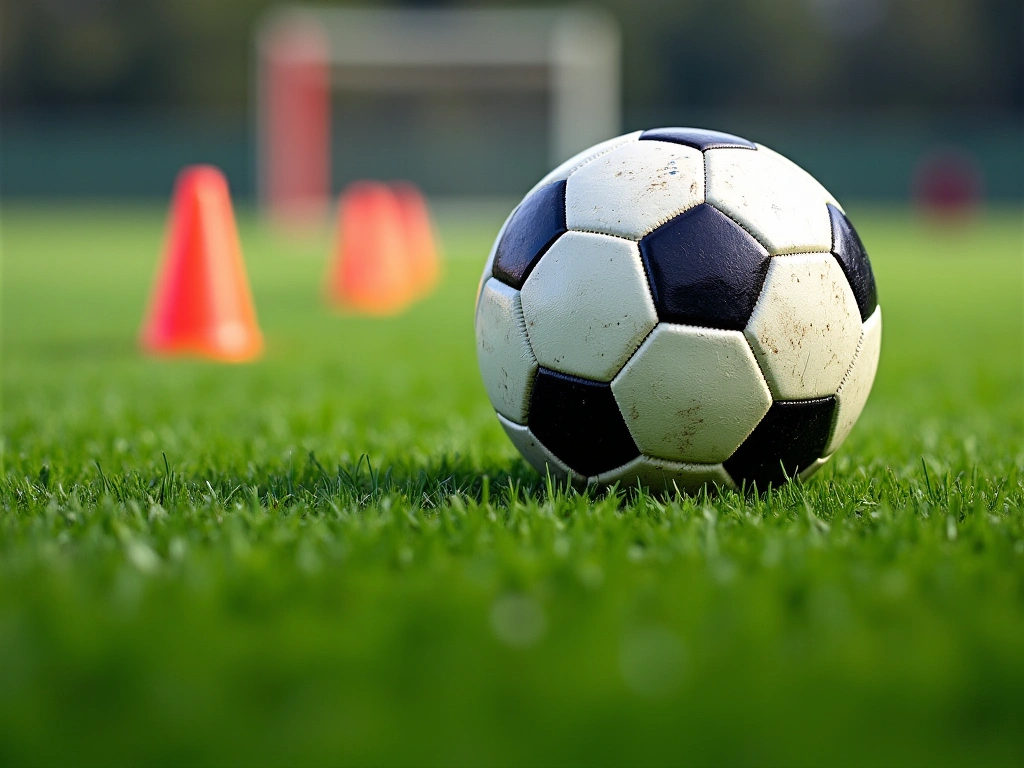
To gamify this, play a variation of “Red Light, Green Light.” On “Green Light,” players dribble freely within a grid. On “Red Light,” they must perform ten toe taps or foundations before freezing. This keeps the heart rate up and forces rapid transitions between running and technical control.
Dribbling Games: Building Confidence in 1v1 Scenarios
Dribbling is the most important skill for an 8-year-old to master. At this age, players should be encouraged to take risks and take on defenders rather than passing the ball away immediately. Confidence comes from knowing they can manipulate the ball in tight spaces.
Sharks and Minnows remains one of the most effective drills for this age group. Set up a large rectangular grid. Most players (minnows) start on one end with a ball, while two players (sharks) start in the middle without balls. The minnows must dribble to the other side without their ball being kicked out by a shark.
This game teaches shielding and close control. Players learn to keep the ball on the foot furthest from the defender, using their body as a barrier. It also forces them to change speed and direction unpredictably, which is the essence of successful dribbling.
Another excellent drill is Cone Weaving Relays. Set up lines of cones and have players dribble through them using specific surfaces of the foot, such as only the inside or only the outside (pinky toe). This forces the ankle to lock and the hips to swivel, mechanics that are essential for high-level play.
Passing Mechanics: The Gate Game
While dribbling is primary, U9 is the right time to introduce the mechanics of the “push pass.” The key technical points are the plant foot (pointing toward the target) and the striking foot (opened up to use the inside surface). Young players often kick with their toes, which leads to inaccuracy.
The Gate Passing Game is a superior alternative to standing in static lines. Place pairs of cones (gates) randomly scattered throughout a 20×20 yard grid. Players pair up with one ball per pair. On the coach’s whistle, they have 60 seconds to pass the ball through as many gates as possible.
This drill encourages movement off the ball. After making a pass, the receiving player must dribble to a new angle or a new gate. It simulates the fluid nature of a real match. To increase difficulty, coaches can require players to use their non-dominant foot or restrict them to two touches.
Communication is naturally built into this drill. Players must talk to their partners to coordinate which gate to attack next. This fosters the early stages of on-field verbal communication, a trait that is often lacking in youth sports.
Shooting and Finishing Under Pressure
Shooting drills for 8-year-olds should focus on technique over raw power. The tendency for young players is to lean back and scoop the ball, sending it over the goal. Coaches must emphasize getting the knee over the ball and striking through the center to keep shots low and powerful.
Breakaway Shooting is a high-excitement drill that mimics game scenarios. Place a goal at one end of the field and a starting cone 25 yards away. A coach stands near the goal with a supply of balls. The coach rolls a ball out, and the player must sprint to it, control it, and shoot before a chasing defender catches them.
This drill adds the element of pressure. Players learn to compose themselves and execute a shot while hearing footsteps behind them. It teaches the concept of the “setup touch,” pushing the ball slightly forward and to the side to open up a striking angle.
For a focus on accuracy, use Target Practice. Place cones inside the goal near the corners. Players receive points for hitting the cones or the side netting. This trains the eyes to aim for the corners rather than shooting directly at the goalkeeper, a common habit among beginners.
Small-Sided Games (SSG) for Game Intelligence
The most effective teacher of the game is the game itself. However, playing full 7v7 or 9v9 matches in practice is inefficient for 8-year-olds. Small-Sided Games (SSG), such as 3v3 or 4v4, are far superior for development.
In a 4v4 scrimmage on a smaller field, the ball is never far away from any player. This forces constant involvement. If a player zones out in a 4v4 game, the team immediately suffers, which naturally encourages focus. There is nowhere to hide, and every player must attack and defend.
Coaches can implement specific rules to shape behavior. For example, a goal only counts if every player on the team has touched the ball in the buildup. Or, goals scored after a successful backward pass count double. These constraints implicitly teach tactics like possession and resetting the play without the coach needing to stop the game constantly to lecture.
Coaching Tone and Positive Reinforcement
The atmosphere created by the coach is just as important as the drills themselves. 8-year-olds respond best to positive reinforcement and clear, concise instructions. Long lectures result in lost attention and cooling muscles.
Use the Sandwich Method for corrections. Start with a compliment, insert the technical correction, and end with encouragement. For example: “Great job getting to the ball, Sarah! Next time, try using the inside of your foot to pass so it goes straight. Keep up the hustle!”
Avoid joystick coaching, where the coach tells the player exactly what to do every second (e.g., “Pass now! Shoot!”). Instead, ask guided questions like, “Where is the open space?” or “What could you have done differently there?” This encourages players to make their own decisions and develop high soccer IQ.
FAQ
What size soccer ball should an 8-year-old use?
Most leagues mandate a Size 3 or Size 4 ball for 8-year-olds (U9). A Size 3 ball is smaller and lighter, making it appropriate for younger or smaller players to develop proper technique without straining their muscles. However, many U9 leagues transition to a Size 4. Always check with your specific league regulations to ensure your child practices with the correct equipment.
How long should a soccer practice be for this age group?
A standard practice session for U9 players should last between 60 and 75 minutes. This duration is sufficient to cover a warm-up, technical drills, and a scrimmage without exhausting the children or losing their mental focus. Extending practice beyond this time often leads to diminishing returns as fatigue sets in and form deteriorates.
How do I handle players who are constantly distracted?
Distraction is normal for 8-year-olds. To minimize it, avoid long lines where kids stand still waiting for their turn. Design drills where everyone has a ball or the wait time is less than 10 seconds. If a player is losing focus, try to re-engage them with a specific, achievable challenge, such as “I bet you can’t do 10 toe taps in 5 seconds.”
Should 8-year-olds play specific positions?
At the U9 level, strict specialization is discouraged. Players should rotate through all positions, including defense and forward. This helps them develop a holistic understanding of the game. A defender needs to know how a striker thinks, and vice versa. Pigeonholing a child into one spot this early can limit their long-term technical development.
What is the most important skill to teach at this age?
Individual ball mastery and dribbling are the top priorities. While passing is important, a player cannot pass effectively if they cannot control the ball first. The ability to receive a pass, settle the ball, and dribble out of trouble is the foundation upon which all other tactical skills are built.
How often should water breaks occur?
Frequent water breaks are essential, especially in warm weather. For a 60-minute practice, plan for at least two or three short breaks. These breaks also serve as transition points between drills, allowing the coach to set up the next activity while the players hydrate and recover.
Is heading the ball safe for 8-year-olds?
Many national soccer federations have banned heading for players U11 and younger to protect against head injuries and concussions. At the 8-year-old level, the focus should remain on foot skills, chest control, and thigh control. Coaches should strictly follow their local league’s safety guidelines regarding heading.